Pizza Fan’s decision to end its collaboration with stand-up comedian Paris Roupos turned into one of the most intense communication crises recently recorded in the Greek market. The incident began as a reaction to one of the comedian’s jokes, but it quickly grew into a social and political phenomenon, sparking a flood of comments on social media and news websites. This incident serves as a reference point for how a brand can find itself -within just a few hours- at the center of a PR crisis that tests its limits, reputation, and communication strategy.
The total mentions on social media and websites reached 11,700 in the past week, with 8,400 mentions appearing in a single day (September 25)! It is truly difficult for a communication and marketing team to handle such a volume of publicity without having previously set up a media monitoring account with the appropriate keywords and alerts.
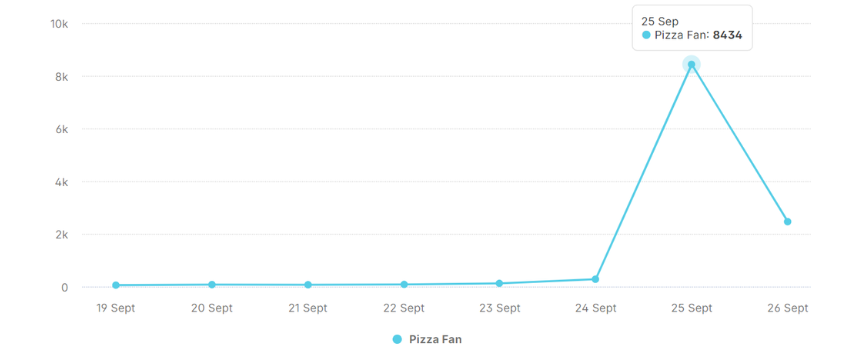
It should be noted that these 8,400 mentions of Pizza Fan do not concern comments under the company’s posts (owned media) but any reference to the brand elsewhere on social media, forums, websites, and blogs. For a brand to have a complete picture of its publicity and the extent of a communication crisis, it is not enough to monitor only the comments under its owned media; it must track the entire spectrum enabled by platforms such as Brandwatch.
Roupos’ comments during a stand-up performance, which included references to the Greek flag and historical events, were deemed offensive, leading to backlash against the pizza delivery chain. The company’s announcements on Facebook gathered thousands of user comments, many of which were negative. However, there were also positive, supportive, and neutral humorous comments.
X (formerly Twitter) fueled the discussion with numerous individual comments and hundreds of reposts. Prominent websites (based on Impact) amplified the incident through relevant publications, including protothema.gr, gazzetta.gr, news247.gr, iefimerida.gr, lifo.gr, and newsit.gr. These well-known websites also shared related posts on their owned channels on Facebook and X (Twitter). The topic was also discussed on Reddit in a thread titled “Pizza Fan fired Paris Roupos: What happened with the well-known comedian”.
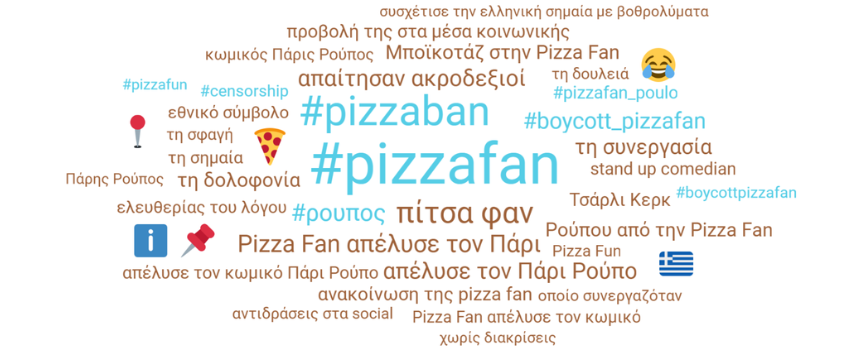
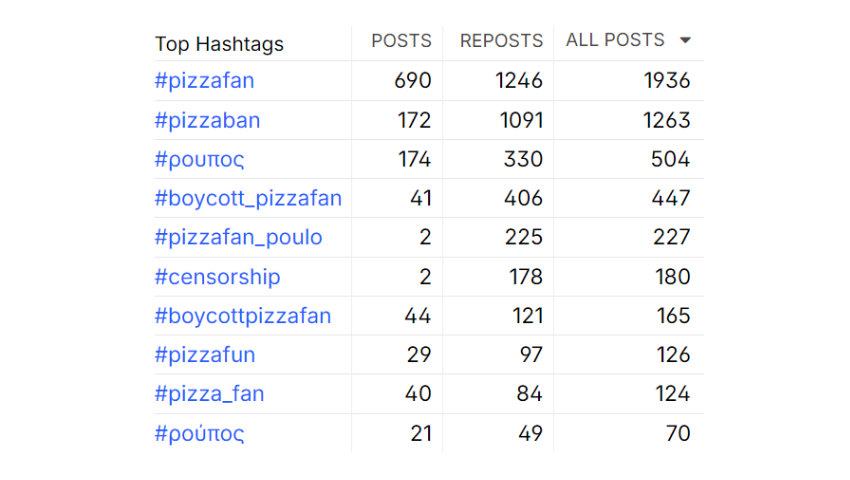
Following Roupos’ dismissal, social media became a battleground for opposing opinions, with some praising Pizza Fan for its stance and others condemning it. Many supporters of Roupos called for a boycott of Pizza Fan using hashtags such as #Pizzaban and #boycottpizzafan. They argue that the company’s decision reflects a capitulation to extreme pressures and emphasize the importance of protecting comedians’ right to satire and critique without fear.
As the reactions continue, Roupos has stated that he intends to take legal action against those he believes incited hatred toward him, including prominent political figures such as Konstantinos Bogdanos. In a YouTube video, Bogdanos called for the comedian’s dismissal, describing his jokes as an “insult to national symbols.”
Beyond the artistic and political dimensions, this case served as a loud reminder of how crucial it is for a company to strategically plan its collaborations. Selecting the right influencer for a brand must follow an in-depth analysis using social listening/digital listening tools like Brandwatch. The content they produce and the audiences they reach must be carefully evaluated before any partnership, as the public tends to associate the creator, directly or indirectly, with the brand. In an environment where the slightest spark can turn into a PR crisis, early risk detection and strategic preparedness become critical factors in safeguarding corporate reputation.
Analysis Identity
Social Listening / Digital Listening: Brandwatch
Date Range: 19-26.09.25
Sources: Internet & Social Media*
Keywording/Analysis: Clip News
*The analysis is based solely on publicly available data from the Internet and social media channels in Greece. The search was limited to the keywords “Pizza Fan” and “Paris Roupos” in various possible variations (English, Greek, Greeklish, with or without accents, etc.).
Search Limitations: The Brandwatch platform collects data from websites, blogs, forums, and social media (X, Facebook, Instagram, Reddit, Tumblr, etc.) subject to the restrictions set by each channel. For example, discussions in closed forums and Facebook private groups, or Instagram stories, are not collected.
The above analysis represents an indicative approach, taking into account that variations in sources and timeframe may produce a different picture.

A Necessary Tool in a Saturated Digital World
Radio & TV Monitoring.. Is it still useful to PR and Communication in the digital media era? Social media and news sites may be dominant, but Radio and TV remain two very powerful pillars of information. They offer directness and emotional connection to the audience that few media can compete with.
Radio & TV Monitoring is paramount in order to understand public opinion, strategically manage one’s reputation and optimize the decision-making process. Businesses that by-pass traditional media risk missing important information that could influence their success.
Radio & TV Monitoring is not important only for businesses. It is equally important for governments, NGOs and public figures who wish to understand public opinion trends and improve their communication strategy.
Direct Access to Information
Real-time Radio & TV Monitoring allows businesses to directly access information about the way major TV and radio stations refer to their brand. Such information allows strategic decision-making, campaign adjustments and crisis management.
Clip News offers alerts that are sent directly to your e-mail about any reference to the keywords you are interested in, making sure you are informed promptly.
Enhancing Reputation with Strategic Interventions
Real-time Radio & TV Monitoring allows corporations to handle their reputation effectively and cultivate a strong and persistent public image. Data analysis allows corporations to spot improvement opportunities. Moreover, content classification and sentiment analysis help detect trends that can guide communication strategies and strengthen the public’s relationship with a specific brand.
Response to Crises: The Power of Direct Response
Negative publicity crises can start as a simple reference and quickly evolve into something much bigger. Radio & TV Monitoring serves as an alert system for brand communication and PR managers. Organizations are able to trace negative developments before they appear on social media and evolve into serious crises. Such direct response contributes to protecting reliability and the trust that the public has placed in one’s brand.
Understanding Competition
Understanding the strategy of its competitors is crucial for every business, as it allows it to stay competitive and always informed about the market’s moves. Radio & TV Monitoring offer businesses the chance to better understand their competitors’ publicity tactics and methodology, and evaluate the impact of their Radio and TV campaigns.
Moreover, further and in-depth data analysis, such as Share of Voice (SoV) and sentiment analysis, offer valuable information about the way a business compares with its competition, as well as about the way in which the public sees its competitors. Such information allows businesses to identify market gaps, adjust their strategies and create more targeted campaigns to maximize their publicity.
AI Technology Revolutionizes Radio & TV Monitoring
With the support of AI, Clip News offers innovative Radio & TV Monitoring solutions. From converting sound into text with an accuracy level above 90%, to collecting data in real time, our innovative platform is extremely easy to use. Automatic translation, advanced search options, along with extraction and storing of data, allow businesses to fully control their content.
Strategic Investment: It is worth it
In a world where information flows endlessly, Radio & TV Monitoring is a powerful tool for businesses. It ensures access to critical information, enhances competitiveness and keeps a brand’s fame at high levels. Investing in Radio & TV Monitoring is also a matter of strategy.
The ability to know what is happening in real time, adjust one’s communication and manage one’s brand accurately is priceless for every modern business. Especially in combination with print, internet and social media monitoring, it offers the complete picture of a brand’s publicity.

Clip News Vice President Katerina Kechagia was for the second time a guest of journalist Takis Spiliopoulos in the show “Review” broadcasted on Naftemporiki TV. This time, the occasion was the recent publication of a Clip News video about managing a Publicity Crisis.
Ms Kechagia highlighted the ways in which modern media monitoring & analysis solutions can make a catalytic contribution to the difficult task that communication and PR professionals have to carry out when they are called upon to manage a negative publicity crisis for the brand they represent.
Early crisis detection through 24/7 media monitoring
Early detection of a Publicity Crisis is the foundation for its proper management. By using 24/7 media monitoring, you can immediately identify negative references or disturbing patterns on Social Media, as well as other sources such as the Internet, the Press, Radio and Television (RTV). A modern monitoring system offers the ability to react quickly, before the crisis escalates and irreversibly affects your brand’s reputation.
Evaluation of publicity data with quantitative and qualitative metrics
Simple monitoring is not enough – you need meaningful evaluation of the resulting data. Through a combined analysis of quantitative and qualitative metrics, you can understand the depth and breadth of the crisis. This process allows you to tailor your message to accurately address the needs and concerns of your audience.
Quantitative metrics include the following:
- Buzz: the total number of posts or comments on the topic
- Evolution: the number of posts or comments per hour or per day
The following stand out in the qualitative metrics:
- Sentiment: the evaluation of publications or comments as positive, neutral, negative
- Top authors: the most important media or most important social media users, based on Reach or Impact
In-depth analysis publicity report after the crisis
The Publicity Crisis may be over, but the work does not stop there. An in-depth analysis publicity report after the crisis is essential to assess what went well, what could be improved and how similar situations can be prevented in the future. Through comprehensive analysis, you gain valuable insights that strengthen your crisis response strategy and improve your communication at all levels.
Watch the full interview on YouTube.
 Portal Login