Portal Login

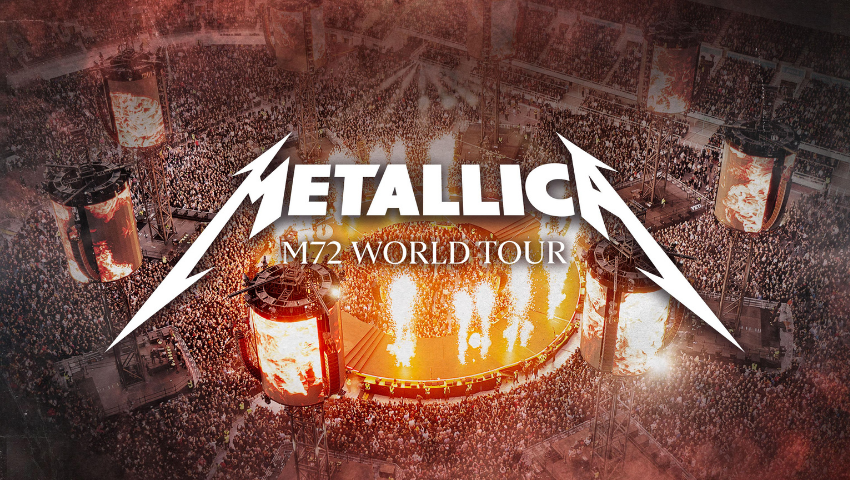

On May 9, 2026, Metallica returned to Athens for the first time in 16 years. Over 90,000 fans packed the Olympic Stadium for a 360° in-the-round show, one that will be hard to forget, and not just for the music. The night’s standout moment was one nobody had on their radar: a live rendition of Mikis Theodorakis’ “Zorba’s Dance”.
But what unfolded outside the stadium was just as remarkable. Within hours, the concert had ignited a massive public conversation across the Greek internet. How does a trend like this take hold? What drives it? And what can brands and communications teams take away from it?
We analyzed the public online conversation surrounding the concert using Brandwatch and the findings are worth unpacking.
Περιεχόμενα
The Numbers That Speak for Themselves
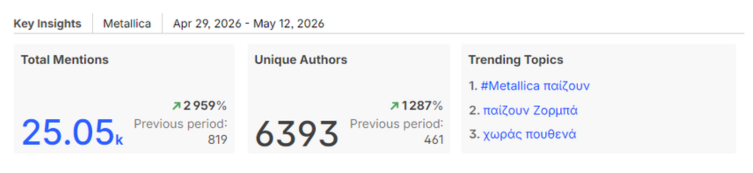
Over a 14-day period, the online conversation around Metallica in Athens generated:
- ~25,000 total mentions
- 6,373 unique authors, distinct voices who actively joined the conversation
- +2,941% increase in mentions compared to the previous equivalent period
- +1,282% increase in unique authors
This wasn’t a handful of viral posts doing the heavy lifting. Over 6,373 different users took part in the conversation, a sign of just how widely and organically it spread.
💡 Insight: A +2,941% spike in mentions isn’t just an eye-catching stat. It illustrates how dramatically the baseline conversation around a brand or event can shift before and after a major moment. For brands, that gap is the window of opportunity.
Where Did the Conversation Happen?
Not every platform plays the same role, and the data makes that clear. 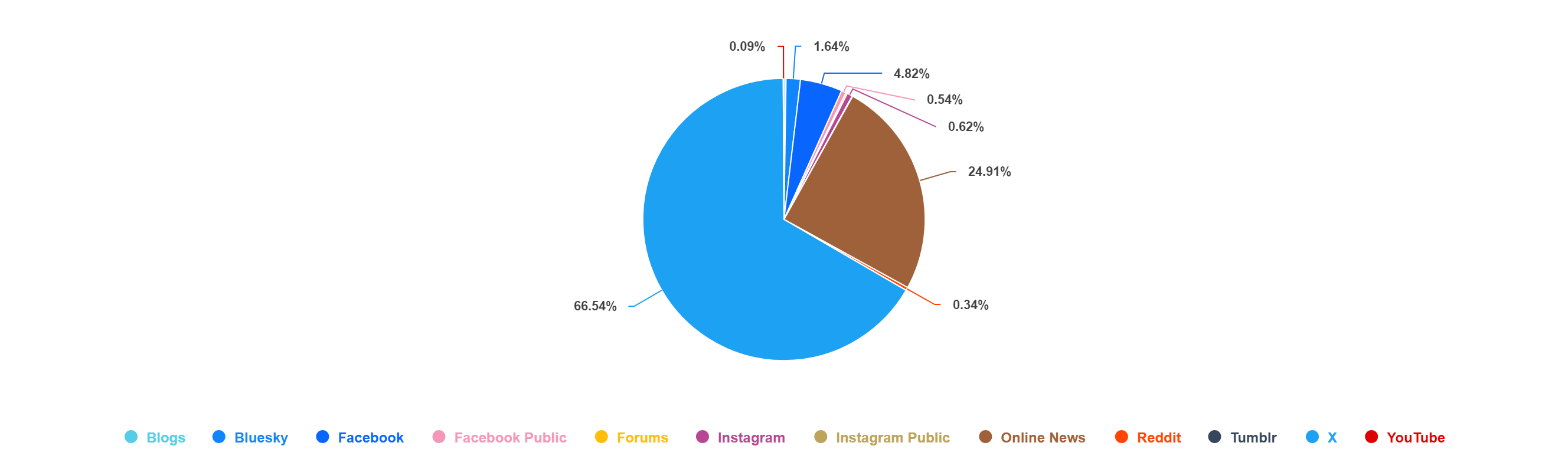 X accounted for 2 in every 3 mentions, and that’s no accident. X functions as a live reaction engine, the place where audiences comment, respond, and amplify content as events unfold. Whether it’s a concert, a sports match, or a political moment, X is almost always where the real-time conversation is happening.
Equally notable: 24.8% of mentions came from online news sources. Nearly 1 in 4 references originated from journalistic outlets, meaning the conversation didn’t stay confined to social media — it spilled over into traditional online media as well.
💡 Insight: If a brand or event has no presence on X during a live moment, it’s effectively absent from the largest share of the conversation happening around it in real time.
The timeline of the Trend
The conversation didn’t start on May 9. It had been building steadily since the beginning of the month. 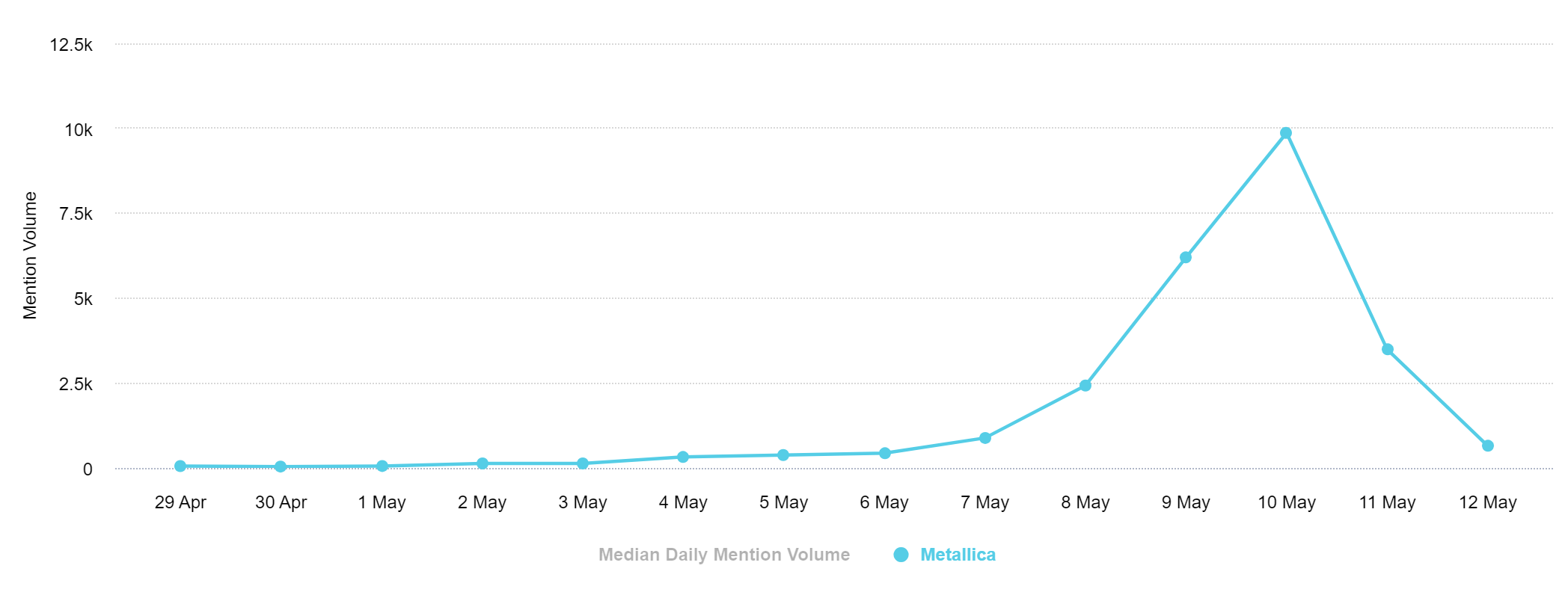
But the timeline reveals something particularly striking: the peak didn’t land on the day of the concert. It came the day after. May 10 recorded 9,864 mentions, 59% more than the day of the event itself.
The explanation is straightforward: videos, reels, reposts, and commentary kept circulating long after the crowd had left the stadium. The event was over. The conversation wasn’t.
What accelerated the trend:
- The live performance of “Zorba’s Dance”. The moment that spread most widely across social media
- Fan-shot videos from inside the stadium, which flooded X in the hours that followed
- A setlist that featured both iconic closers (“Master of Puppets” and “Enter Sandman”) made possible by the one-night-only format
- The ticket price debate, which reignited in the post-event discussion
💡 Insight: Major events don’t peak once and fade, they have an afterglow. The post-event window is often just as valuable as the day itself, and brands that recognize this can make the most of both.
What People Were Actually Talking About
The numbers tell us how many people spoke. The posts tell us what they actually said.
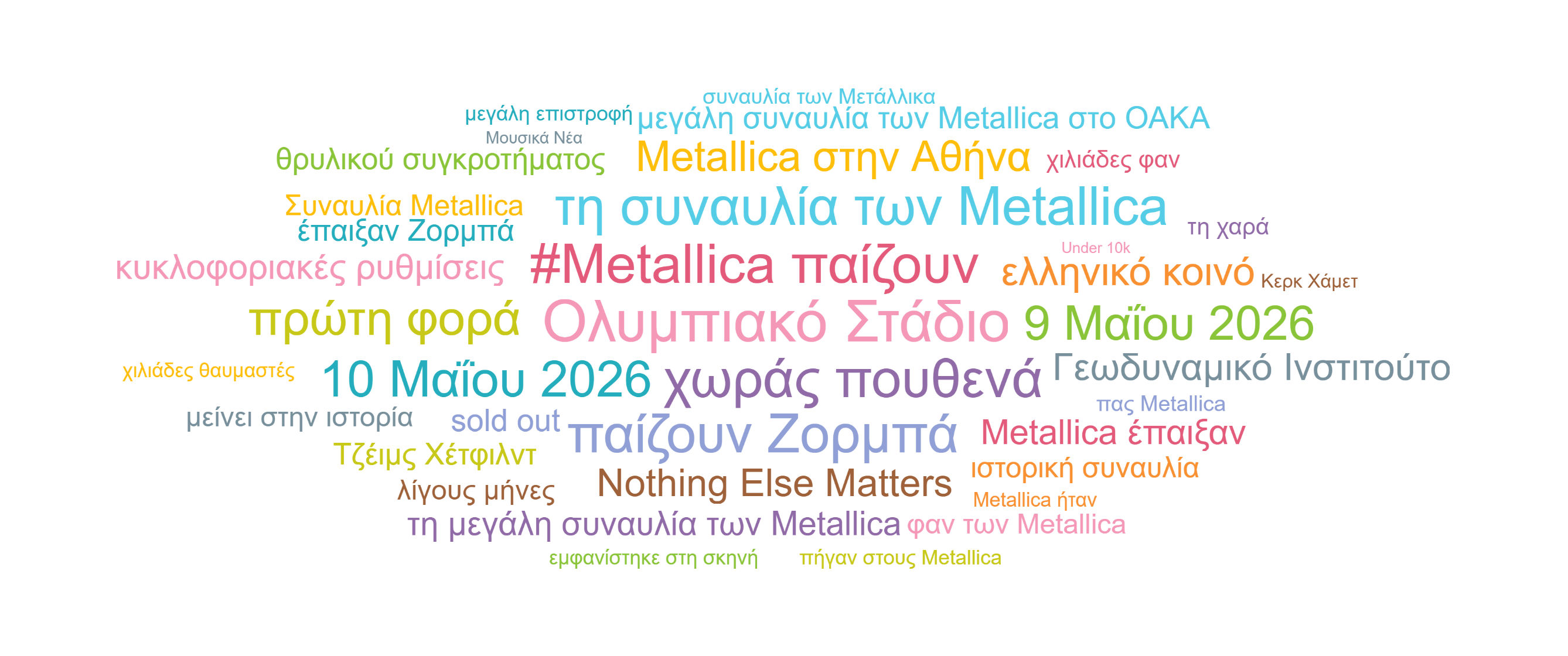 Reading through the mentions reveals that the conversation stretched well beyond the concert itself. At least five distinct themes emerged:
“Zorba’s Dance” as a viral moment
The performance by Kirk Hammett and Robert Trujillo became the night’s defining talking point. Posts described it as “epic,” “unforgettable,” “a tribute to Greece” — and it was shared widely across platforms.
The ticket price debate
One of the most persistent threads was a price comparison, with many users arguing that €150 for Metallica is “a steal” compared to what Greek artists charge. That particular post became one of the most shared of the evening.
Fandom identity and “true fan” debates
A number of users questioned whether people who attended are “real” metal fans — a dynamic that surfaces at virtually every mainstream metal event, and one that speaks to how deeply music is tied to personal identity.
Nostalgia and cultural commentary
Many posts reflected on the significance of Metallica’s return after 16 years, and what it means for Greece to be hosting events of this scale again.
Comparisons and future wishlists
Almost immediately after the show, speculation turned to which band might come next with AC/DC emerging as the clear fan favourite.
💡 Insight: A major event doesn’t generate one conversation. It generates many, running in parallel. Social listening lets you identify them, make sense of them, and if you’re a brand decide which ones you actually have something to contribute to.
One of the most revealing patterns from the analysis is the dynamic between social media and online media and the direction it flows.
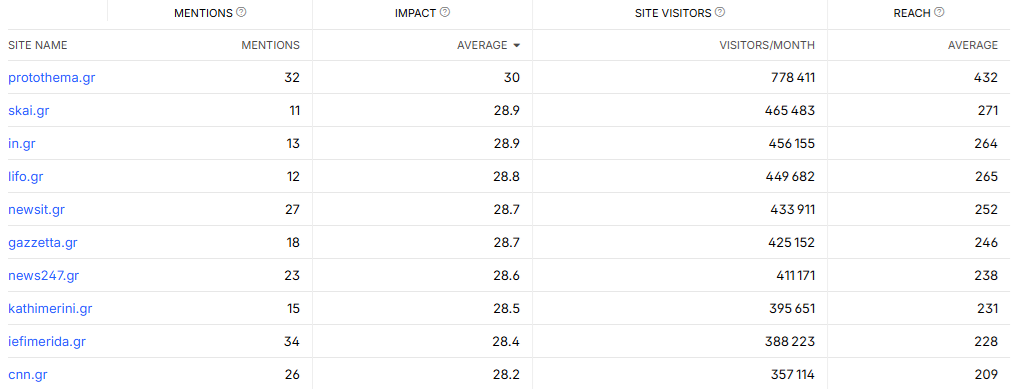 Online media didn’t create the trend. They amplified it. The community on X moved first: hashtags, videos, reposts, reactions. Online outlets then picked up the story, drawing on what was already in circulation. And that coverage fed back into social media, generating another round of shares and commentary.
One detail worth noting: gazzetta.gr, a sports-focused site, ranked among the top sources. This reflects the crossover many users drew between the concert and sporting references: stadium capacity, crowd size, comparisons to major sports events.
💡 Insight: In modern communications, social media and online media don’t operate in silos, they fuel each other in a continuous loop. A strategy that focuses on only one side is working with an incomplete picture.
Key Takeaways for Brands and Communications Teams
The Metallica concert in Athens wasn’t just a music event. It was a real-world case study in how public digital conversation forms around a major moment — and it leaves behind some clear lessons.
- Real-time monitoring matters before, during, and after.
The trend didn’t start on May 9, and it didn’t end there either. Brands and organizations that track the conversation only on the day of an event are missing critical context on both ends. - X is still where live conversation happens.
Despite the growth of other platforms, X remains the dominant space for real-time public discourse. If your audience is talking there, you need to be there too. - Unexpected moments are the ones that move people.
“Zorba’s Dance” wasn’t on the official setlist and it became the most shared moment of the night. Moments like these can’t be scripted, but they can be spotted and acted on in real time. That’s exactly what social listening is for. - Social listening isn’t just measurement, it’s understanding.
25,000 mentions tell you that people talked. What they said, why they said it, and where they said it, that’s the intelligence. And that’s what allows brands and communications teams to make decisions based on evidence, not guesswork.
In an environment where public conversations shift in real time, social listening has moved well beyond basic monitoring. It’s a tool for understanding how your brand, or any story, is perceived, how trends form, and how audiences behave.
Clip News provides social media monitoring and social listening services for brands and communications agencies, combining data and analysis to surface insights that actually matter. To find out more, fill in the form below and we’ll be in touch.
Analysis Profile
Social Listening Tool: Brandwatch
Date Range: April 29 – May 12, 2026
Sources: Social Media*, online news, blogs and more
Scope: Public online mentions and social conversations in Greek and English
Keywording/Analysis: Clip News
*The analysis draws exclusively on publicly available social media data. The search was built around the keyword “Metallica” across all possible variations, English, Greek, Greeklish, accented and unaccented, along with relevant hashtags (e.g. #Metallica, #MetallicaAthens, #M72WorldTour).
Search Limitations: Brandwatch collects data from websites, blogs, forums, and social media platforms (X, Facebook, Instagram, Reddit, Tumblr, etc.), subject to each platform’s own restrictions. Conversations in closed forums, private Facebook groups, or Instagram Stories, for example, are not captured. This analysis should be read as an indicative snapshot; different source selections or time ranges may produce different results.