
What should you evaluate before deciding where to invest your time and budget in the year ahead?
For many businesses, November and December are when communications plans for the coming year begin to take shape. New objectives, campaigns, communication channels and budgets are all on the agenda. But how many of these decisions are based on solid evidence, and how many rely on assumptions?
“We believe our brand’s reputation has improved.” “Our latest campaign performed well.” “Our competitors are getting more media attention than we are.” These statements may well be true. Without a systematic evaluation, however, they remain assumptions.
Before finalizing your communications plan for 2027, consider these five essential questions.
1. What picture of your brand emerged in 2026?
The number of media mentions and social media references is a useful indicator of your brand’s visibility. But numbers alone cannot tell you how your brand is being perceived An increase in media coverage might be driven by a successful corporate initiative or by an incident that sparked negative reactions. To build a more complete picture, look at:
- Key topics: Which issues and conversations was your brand most frequently associated with?
- Sentiment: How did the balance of positive, neutral and negative mentions evolve?
- Coverage trends: Which events triggered significant increases or decreases in media mentions?
Quantitative and qualitative media analysis can reveal not only how often your brand appeared in the media, but also the context surrounding that coverage.
A question to ask yourself: Do you know how many mentions your company received, and can you explain what drove that coverage?
2. How effective were your communications activities?
A campaign that generates extensive media coverage has not necessarily achieved its communications objectives.
For example, if your goal was to raise awareness of a new service, counting the resulting media mentions is only a starting point. You also need to assess whether your key messages were communicated, whether coverage appeared in relevant media outlets and whether those outlets reached your intended audience.
Equally, a campaign with fewer mentions may deliver greater communications value if it secures meaningful coverage in carefully targeted media. When evaluating your communications activities, consider:
- The media coverage generated by each campaign, announcement or corporate initiative.
- How consistently your key messages appeared in that coverage.
- How relevant the media outlets and sources were to your target audiences.
Media analysis can help assess how effectively your messages were communicated through the media. Measuring broader outcomes, such as changes in audience attitudes or sales, requires additional data. This distinction is also central to the Barcelona Principles V4.0, which emphasize the importance of looking beyond media coverage when evaluating communications performance.
A question to ask yourself: Do you evaluate your communications activities by the volume of coverage they generate, or against the objectives you set from the outset?
3. How did your media presence compare with your competitors?
Evaluating your communications performance becomes more meaningful when you consider it in the context of your wider market. Which competitor initiatives attracted the most media attention? Which topics did they dominate? Which partnerships or announcements generated significant coverage? Systematic competitor monitoring can reveal communications priorities, emerging trends and opportunities to differentiate your brand. One useful metric is Share of Voice (SoV), which measures the proportion of media coverage your brand receives compared with selected competitors, within a defined set of sources and topics.
For a meaningful comparison, examine:
- Your brand’s Share of Voice relative to key competitors.
- The topics on which each company gained the greatest visibility.
- The communications activities and initiatives that stood out throughout the year.
A question to ask yourself: Do you know where your brand has a stronger media presence than its competitors, and where there is room to improve?
4. Which media channels and sources contributed most to your coverage?
Not all media outlets and digital platforms are equally relevant to every business. For some organizations, coverage in financial and industry-specific publications may be particularly valuable. For others, public conversations on social media, television, radio or coverage in international markets may play a more important role.
Evaluating your media coverage by source helps you understand where your brand is gaining visibility and which channels deserve closer attention in your plans for the coming year. Focus on three areas:
- Coverage distribution: Which types of media generated the most mentions?
- Source relevance: Which media outlets and platforms reach the audiences that matter to your business?
- Communications opportunities: Are there channels or markets with potential that are not currently part of your strategy?
The volume of media mentions does not necessarily reflect influence. Assessing the value of a source also requires an understanding of its content, its relevance to your target audience and, where data is available, its actual reach and impact.
A question to ask yourself: Are your communication channel choices driven by data, or mainly by the approaches you have followed in previous years?
5. What will you do differently in 2027?
The value of a year-end communications review goes beyond documenting what happened. What matters most is how you use those findings to inform future decisions. If your analysis reveals limited visibility around an important industry topic, you can make strengthening that presence a priority. If certain key messages did not receive the exposure you expected, you can adjust your communications approach accordingly. The next step is to turn these findings into specific, measurable objectives.
For example:
- Build visibility around a strategic topic: Track relevant media mentions and changes in Share of Voice.
- Improve communications around new products or services: Evaluate key message coverage and visibility in targeted media outlets.
- Gain a better understanding of public perception: Regularly analyze sentiment, key topics and shifts in media coverage.
It is equally important to decide how frequently you will review performance. Monthly reporting can support marketing and communications teams in their day-to-day decisions, while a more consolidated quarterly analysis can give senior management a clearer view of progress.
Establishing your monitoring processes and performance metrics early allows you to begin the year with a consistent measurement framework. This makes it easier to compare results over time, starting from the beginning of 2027.
A question to ask yourself: Have you only defined what you want to achieve in 2027, or have you also decided how you will measure your progress?
From Reviewing Performance to Planning Ahead
If you found some of these questions difficult to answer, it may be worth reassessing the data you use to evaluate your communications. Identifying these gaps is a valuable first step towards planning for the year ahead.
Through its Media Monitoring and Reporting & Analysis services, Clip News helps businesses evaluate their media coverage, monitor competitors and turn findings into informed communications decisions.
Planning Your Communications for 2027?
Contact us using the form below, or request a free demo to discover how Clip News’ Media Monitoring and Reporting & Analysis services can help you achieve your communications goals.
How to Get a Complete Picture of Your Brand Reputation and Competitor Activity
In today’s business environment, social media is a living organism that constantly generates data, opportunities and, at times, crises. For any company that wants to stay ahead of the curve, the critical question is no longer whether to have a social media presence, but how to listen to and analyse everything that happens on it.
Every day, millions of users talk about brands, products and trends, often without tagging the official company page. Within this ocean of information, Clip News offers the strategic compass that every modern Marketing department and PR agency needs: social media monitoring for companies. To get a truly 360° view of their market, businesses need a combination of two complementary services that, while distinct, work hand in hand.
1. Keyword Monitoring: Your Brand’s Listening Tool
Imagine being able to sit in on every online conversation where your company name, your products or even your direct competitors are mentioned. That is exactly what Keyword Monitoring gives you.
Through targeted keyword-based tracking, you can monitor in real time what consumers are saying about you on Facebook, Instagram, X, LinkedIn, TikTok and YouTube. Crucially, the tracking works even when users have not tagged your official company page.
It is the ultimate reputation management tool, allowing communications teams to respond immediately to negative comments before they escalate into a crisis, while also identifying positive mentions that can be turned into valuable brand advocacy. Every mention comes with full metrics, including follower count, likes, shares, post URL and date, turning raw data into strategic decisions.
2. Page Monitoring: Keeping an Eye on Competitors and the Market
While Keyword Monitoring focuses on what is being said, Page Monitoring focuses on who is saying it and how the market is moving overall. It involves the systematic monitoring of specific pages and accounts (Facebook Pages, Instagram Accounts, LinkedIn Accounts, X profiles and more) that are strategically important to your business.
Here, the focus shifts to the activity of competitors, partners and industry influencers. What campaigns are they running right now? What engagement are they achieving? How is their audience responding? With Page Monitoring, you gain valuable benchmarks and insights that allow you to adjust your own strategy based on real data, not guesswork.
Stronger Together: Why You Need Both
A common mistake many companies make is choosing only one of these two approaches. But fragmented information leads to incomplete conclusions.
- If you rely solely on Keyword Monitoring, you will know what is being said about you, your industry or your competitors across social media. But you will miss the structured content strategy that competitors, partners and industry influencers are following through their official channels: what they are publishing, when, how often and how much engagement each post is generating.
- Conversely, if you focus only on Page Monitoring, you will see what others are publishing on their pages and how their content is performing, but you will miss the organic user conversations that are actively shaping your brand’s reputation.
Using both Clip News services together ensures nothing is left to chance. It is the difference between simply being on social media and truly owning it.
In the information age, knowledge is power, but the right filtered information is the ultimate competitive advantage. Clip News, with years of experience and advanced technology, transforms thousands of social data points into actionable knowledge, helping businesses make decisions with confidence.
To find out more about our Keyword and Page Monitoring solutions, get in touch by filling in the form below.
This article was originally published on epixeiro.gr on 11/05/2026.
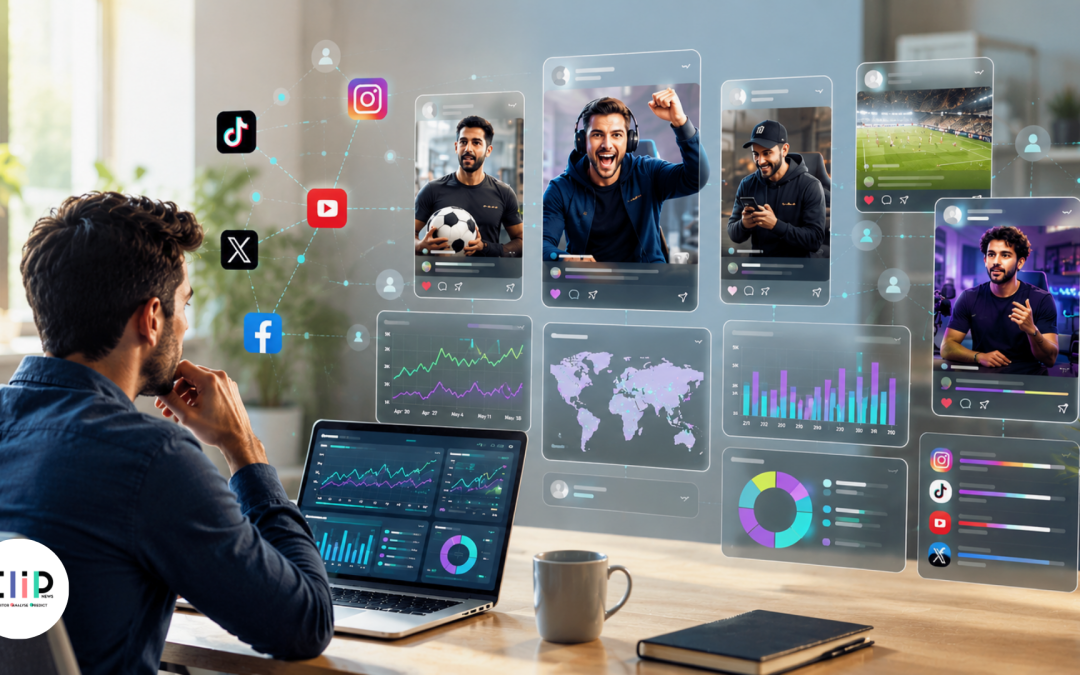
Why monitoring creators and competitors on social media is becoming a key tool for betting marketing teams
The online betting market in Greece has matured. A few years ago, social media was just another channel that companies were testing out. Today, it is a core competitive battleground, with creators, betting shows, YouTube channels and sports media pages producing high volumes of content about the industry every single day. In this landscape, betting social media monitoring has become a key tool for marketing teams. The challenge is no longer a lack of information. It is knowing how to systematically track what is happening around your brand and turn that information into decisions.
From Volume to Quality
For many years, the logic was simple: more creators meant greater reach. Today, however, marketing teams are juggling dozens of simultaneous partnerships across multiple channels. Each one comes with its own terms, deliverables and audience.
That volume has created a new problem: not a lack of content, but a lack of visibility. Two areas are drawing increasing attention: monitoring creator partnerships and competitive intelligence on social media.
Creator & Sponsorship Monitoring: What Was Actually Published?
Every collaboration with a creator or sponsored account typically involves specific terms: publication timing, hashtags, promotion of specific offers and content format. But who actually verifies that everything was delivered as agreed? In practice, marketing teams need answers to straightforward but critical questions:
- Was the agreed content published?
- When was it published and on which platform?
- Did it include all the agreed elements?
- What was its performance?
- Which creators deliver the best results per channel?
When partnerships are few, manual checks are manageable. When you are tracking dozens of accounts across multiple channels at once, the process quickly becomes time-consuming and things start falling through the cracks.
In practice
A betting company found that several creator posts were difficult to track down after the fact, especially when they had gone live across different platforms at different times. Through automated monitoring, the marketing team gained a consolidated view of all relevant posts and their key metrics. This significantly reduced the time spent on verification and made it far easier to evaluate partnerships and report results internally.
Competition Monitoring: What Are Competitors Doing and When Do You Find Out?
Competitive intelligence on social media is one of the most underrated advantages a marketing team can have in the betting industry. It is not about copying what competitors do. It is about understanding where the market is heading and being able to make decisions based on data, not gut feeling.
Systematically monitoring competitors’ social media pages gives marketing teams visibility into:
- Posting frequency per platform
- The creators each brand is working with
- The key topics being promoted
- The content formats that perform best
- The platforms driving the most engagement
In practice
By tracking its main competitors across Instagram, TikTok, Facebook, YouTube and LinkedIn, a betting company was able to analyse which creators each brand was working with, which content formats drove the highest engagement and how often each competitor was putting out content.
The team did not copy the competition. They studied it and used those insights to shape their own strategy.
The Solution: Social Media Page Monitoring
At Clip News, we built a dedicated betting social media monitoring service to give marketing teams in the betting industry full, automated visibility of their creators, partners and competitors across TikTok, Instagram, Facebook, X, YouTube and LinkedIn. The service automatically collects posts and delivers key metrics, including likes, comments, shares, views, engagement score, followers and publication date, all from a single platform, in real time.
From Scattered Data to a Unified View
Monitoring gives you the data. A unified view gives you direction.
Today, marketing teams at betting companies have to keep track of an increasingly complex ecosystem. Creators, partners, betting shows, sports media pages and competitors all generate large volumes of activity every day, and manual monitoring simply cannot keep up.
The real value lies not just in capturing all of that activity, but in being able to consolidate, organise and act on it, so you can evaluate partnerships more effectively, spot trends earlier and make decisions based on what is actually happening.
If you would like to see how it works for your company, get in touch using the form below and take advantage of our Social Media Monitoring offer: 2 months free on an annual subscription covering all social media channels (Facebook, Instagram, LinkedIn, TikTok, X, YouTube).
If you would like to receive a sample report for your industry, drop us an email at marketing@clipnews.gr with the subject line “Sample Betting Report”.

For many years, competitor monitoring relied on limited sources of information: advertising campaigns, press releases, corporate announcements, or media coverage. Today, however, a large part of business strategy unfolds publicly on Social Media. Corporate accounts on Facebook, Instagram, TikTok, LinkedIn, X, or YouTube no longer function solely as promotion channels. They also serve as a window into companies’ communication and marketing strategies.
Social Media as a source of strategic intelligence
Each post on Social Media conveys information about how a company chooses to communicate with its audience. Through the systematic monitoring of corporate accounts within an industry, valuable insights can emerge, such as:
- which campaigns are currently running
- which products or services are being promoted more intensively
- which collaborations with influencers are activated
- which types of content generate higher engagement
- which trends are beginning to shape the market
In other words, Social Media has become one of the most direct ways to understand the dynamics of an industry.
When information becomes a competitive advantage
For marketing and communication teams, monitoring Social Media activity goes beyond simple awareness. It becomes a strategic analysis tool. The systematic recording and analysis of corporate account activity enables businesses to:
- identify trends before they become widely visible
- evaluate the effectiveness of specific content formats
- better understand competitors’ communication strategies
- identify opportunities to differentiate their own campaigns
In an environment where developments move quickly, timely information can provide a significant advantage in decision-making.
From fragmented monitoring to systematic analysis
Many businesses monitor competitor accounts occasionally. However, fragmented observation rarely leads to meaningful conclusions. Systematic monitoring of specific pages on Social Media enables structured content tracking, analysis of posting frequency, and evaluation of audience engagement. This process helps businesses gain a more comprehensive view of the market’s communication strategy.
The importance of Social Media Page Monitoring
In this context, Social Media Page Monitoring emerges as a key tool for businesses and organizations that want to maintain continuous visibility over industry activity. Monitoring corporate accounts, influencer pages, and other important Social Media accounts enables the timely tracking of market movements and a deeper understanding of competitors’ strategies. Clip News provides Social Media Page Monitoring services that enable structured monitoring of key Social Media accounts, offering businesses a more comprehensive view of developments within their industry.
Is your business ready for the next step?
In today’s digital environment, a significant portion of business activity takes place publicly. Campaigns, partnerships, and communication strategies are reflected daily on Social Media. The question is not whether this information exists. The question is whether businesses have the tools to systematically monitor it.
Contact us through the form below and take advantage of the Social Media (Keyword and Page) Monitoring offer, gaining 2 months free of charge on an annual subscription for monitoring all Social Media channels (Facebook, Instagram, LinkedIn, TikTok, X, YouTube)!

There is a common myth in the business world: “Since our company doesn’t have an official channel on TikTok (or any other Social Media channel), we don’t need to know what’s happening there.”
In reality, this approach is like sitting in a room with your ears covered while everyone in the next room is talking about you. Whether you choose to have an owned presence (your own corporate accounts) on Social Media is a strategic marketing decision. Whether the public chooses to talk about you, however, is a reality you cannot control – you can only monitor it.
The Illusion of Absence
Your absence from a platform does not imply the absence of your brand from user discussions. Today’s consumers generate content (UGC) incessantly. A review of your product, an experience at your store, or even a complaint can go viral on TikTok or Instagram within hours.
If you don’t perform monitoring, you risk finding out about a crisis that started on Social Media only after it has reached proportions that are difficult to reverse. Monitoring is not just “measurement”; it is an early warning system.
How Clip News Illuminates the “Blind Spots”
At Clip News, we help companies understand that Social Media Monitoring isn’t just about their own posts. Our service is divided into two main pillars that cover every information need:
Social Media Keyword Monitoring: Here, the focus is on your brand and the keywords that concern you. We detect mentions across the entire Social Media spectrum, identifying what users are saying about you, even if they don’t tag you. It is the only way to hear the “voice of the customer” where it is expressed spontaneously.
Social Media Page Monitoring: Strategy isn’t just about you; it’s also about your environment. Through this service, we monitor the activity of competitors, partners, or influencers. What feedback is your competitor receiving? What trends are industry influencers highlighting? This information is “gold” for your next strategic move.
Silence is Not Always “Golden”
Not knowing what is being said about your company on channels like TikTok, X (Twitter), or Instagram leaves you exposed. Social Media Monitoring gives you the information advantage, allowing you to:
- Prevent communication crises before they escalate.
- Identify opportunities for product improvement through user feedback and needs.
- Understand the market sentiment and competitor moves in real-time.
Opening an account on a new platform is optional. However, knowing what is happening there is essential to protect and grow your brand.
Contact us through the form below and take advantage of the Social Media (Keyword and Page) Monitoring offer, gaining 2 months free of charge on an annual subscription for monitoring all Social Media channels (Facebook, Instagram, LinkedIn, TikTok, X, YouTube)!
 Portal Login

