
Why numbers don’t tell the whole truth
In the world of communication and PR, reports and dashboards are filled with KPIs: reach, impressions, publicity volume. However, the truth is that numbers alone are not enough. The Barcelona Principles V4.0 of the International Association for the Measurement and Evaluation of Communication (AMEC) remind us that quantitative data must be combined with qualitative analysis.
This principle needs to permeate the entire field of communication; therefore, it also concerns the measurement and evaluation of a brand’s image on social media. In other words, social listening does not simply mean measuring how many times your brand has been mentioned on social media, but understanding “the why” and “how” behind every discussion, post, and reaction from the audience.
Real-time insights
In our times, a TikTok video can go viral within minutes or a tweet can gather hundreds of reposts. Real-time monitoring is a prerequisite for the survival of brands. By utilizing social listening tools, they detect trends before they become mainstream, adjusting the message and positioning accordingly.
Of course, when we talk about social listening, we don’t mean just monitoring your own posts, but any mention of the brand, anywhere on social media:
- Owned: The posts that you upload on the official social media pages of the brand, e.g., Facebook, LinkedIn, Instagram.
- Earned: The organic exposure that the brand gains without paying, e.g., comments, mentions.
- Shared: The content that is reproduced by the public, e.g., reposts, shares.
- Paid: It differs from paid advertising and refers to paid content, e.g., an Instagram post from a fashion influencer that was made after a commercial agreement with the brand.
Benchmarking forever
One of the most underrated advantages of social listening is the comparison with the competition. It is not only important how users talk about your brand but also how you position yourself against competitors. Besides the well-known share of voice (SoV), a deeper analysis of the data is needed, with measurements such as: SoV with sentiment (positive, neutral, negative) and SoV by social channel. Through continuous mapping of the dialogue, you can identify gaps left by other players and build a more targeted strategy.
Management starts before the crisis
Crises usually catch us off guard, but they do not arise suddenly. They begin with a negative experience with a retail chain posted on X or with a thread in a forum about a new car model. The ability to detect such warning signals in time through social listening can be the difference between a manageable situation and a blow to the brand’s reputation and sales.
From data to strategy
The time when companies could rely solely on post-campaign reports is over. The leading brands are those that have the ability to understand not only what is being said, but why it is being said and how this can be reversed or leveraged. In fact, social listening is a direct “X-Ray” that reveals the health of a brand, the dynamics of a market, and the psychology of the audience. The result is a more flexible communication strategy based on data.
The article was published on Daily Fax on September 24, 2025.
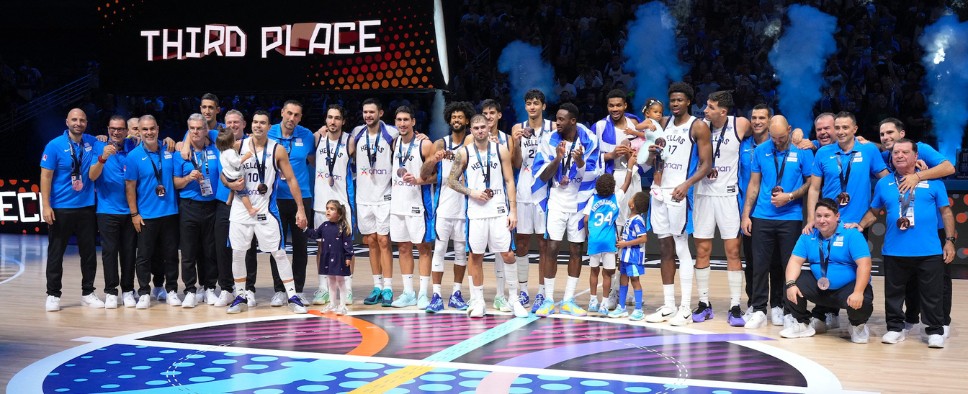
From August 27 to September 16, 2025, we analyzed more than 138,000 posts and comments on social media (X, Facebook, forums) regarding the participation of Greece men’s national basketball team in EuroBasket 2025, based exclusively on data from the Brandwatch platform, a global leader in social listening.
Objective: To understand how the team’s journey was reflected on social media, what the dominant sentiment was, and how the discussion transcended the boundaries of sports, touching on politics, national identity, and the overall image of Greek basketball.

Top Buzz Peaks
Comments and posts on social media recorded a huge increase on September 7 (VS Israel), on September 12 (VS Turkey), and on September 14 (VS Finland):

September 7 (VS Israel): Greece advanced to the quarter-finals after a thrilling victory with a score of 84-79, led by Giannis Antetokounmpo (37 points). The match generated huge buzz on social media as it combined athletic excellence and political tension. On social networks, expressions of national pride dominated on one hand, while politically charged hashtags (#freepalestine) were prominent on the other, linked to the developments in Gaza. A significant part of the discussion focused on the demand of Greek opposition political party SYRIZA to cancel the match. Despite the political tension, the victory became a point of unity and joy for the fans.
Indicative X posts with a significant number of RTs:

September 12 (VS Turkey): Greece lost with a score of 68-94 in the semi-final, in a match where they made 22 mistakes and never found their rhythm. The Turks, with Osman and Sengun as key players, completely dominated. There was widespread disappointment and intense criticism on Greek social media regarding the team’s and the coach’s choices, but also supportive comments.
Indicative X posts with a significant number of RTs:

Sengun’s post on social media after the game sparked reactions on Greek social media, as it seemed to reference the 1922 Asia Minor developments. The Turkish Federation also caused strong reactions with a post showing a Turkish player dunking in front of Antetokounmpo with the caption “No mercy.” This image led to an official complaint from the Hellenic Basketball Federation to FIBA and was eventually withdrawn. The tension on social media was twofold: sporting (criticism of the team) and political, intensifying the atmosphere of confrontation between Greece and Turkey.
Indicative X posts with a significant number of RTs:

September 14 (VS Finland): Greece won the bronze medal after 16 years, beating their opponent 92-89, with the last 5 minutes causing a stir on social media. The match was characterized by passion and teamwork, with Greece showing character and regaining their spirit after the loss in the semi-final. Emotional moments were recorded and commented on social media: Antetokounmpo, with the Greek flag on his back, was in tears, stating that “this is the greatest achievement of his career,” and team captain Kostas Papanikolaou expressed emotion and commitment for the future of the team. The discussion focused on the meaning of returning to the podium, national pride, and the new era that is opening up for Greek basketball.
Indicative X posts with a significant number of RTs: 
Sentiment Analysis
Sentiment analysis on social media shows a mainly positive image. The progress of Greece men’s national basketball team created emotional identification, with the positive tone prevailing in discussions about winning the medal.
- 54,64% positive (celebrations, national pride, exaltation of players and the coach)
- 35,97% neutral (descriptive posts, journalistic reports)
- 9,39% negative (criticism for the defeat against Turkey, political reactions to the match with Israel).

Sources Benchmarking
From September 7 (match against Israel) onwards, X took off with almost 100k mentions (+557% compared to the corresponding previous period). Public comments on Facebook saw a more moderate increase (+34%). Forums had a limited presence, but also saw a significant increase (+62%), showing that qualifying for the quarter-finals and the subsequent matches generated intense activity across all channels examined.

Notable peaks for Facebook and forums:
On Facebook, hundreds of public comments were gathered in the following posts, among others:

Related comments in forums recorded an increase on September 13 in threads with titles:
- “The thread of the official favourite – National basketball team” (on insomnia.gr)
- “Eurobasket 2025 and the end of an era” (on adslgr.com))
Countries & Key Players
Greece accounted for 72.4% of the total discussion, while the countries most frequently mentioned by Greek users on social media were Turkey (9.54%) and Israel (4.94%):

This shows that the discussion was strongly national in nature, but at the same time, specific countries were key points of reference as the discussions expanded to political issues.
Giannis Antetokounmpo was at the center of the discussion with 57% of mentions, as the undisputed leader on the court. He was followed by coach Vassilis Spanoulis (21.9%), Kostas Sloukas (11.2%), and team captain Kostas Papanikolaou (9.8%):

The Greek Freak’s leadership, both on the court (37 points against Israel, decisive moments in the bronze medal match) and symbolically (statements about the medal as ‘the greatest achievement of his life’), strengthened the team’s image and gave a new dimension to the discussion about identity and national pride.
Hashtags, Phrases & Emojis
The topics cloud highlights how the discussion combines sports, national identity and politics:

- Dominant hashtags: #eurobasket, #eurobasket2025, #grefin, #gretur, #greisr
- Phrases: “bronze medal”, “Greek national team”, “Congratulations”
- Emojis: 🏀👏🇬🇷❤️, expressing enthusiasm and national pride
At the same time, the discussion about the match against Israel was linked to hashtags such as #freepalestine, showing how political dynamics have penetrated the sporting dialogue.
Why Social Listening is Valuable
The analysis of Greece’s participation in EuroBasket 2025 clearly highlights the power of social listening:
- Identification of discussion peaks related to matches, results and critical events.
- Understanding the sentiment and how social media users experience the Greek national team’s progress.
- Highlighting the political and social dimensions that influence the image of a sporting event.
- Mapping key players and how they reinforce or influence public discourse.
For communications, marketing and PR professionals, the ability to monitor social media conversations in real time offers a strategic advantage:
- Enhancing positive publicity.
- Preparing for crises.
- Leveraging insights to improve products or services, content marketing, sponsorships and partnerships.
Try out the possibilities of social listening for your own industry, utilizing real-time data. Identify critical trends, valuable insights and opportunities that will give you a competitive edge.
Analysis Identity
Social Listening Tool: Brandwatch
Date Range: 27/08/25 – 16/09/25
Sources: Social Media*
Keywording/Analysis: Clip News
*The analysis is based solely on publicly available data from social media channels in Greece. The search was limited to the keywords “Eurobasket” and “National Basketball Team” in all possible variations (English, Greek, Greeklish, with or without accents, etc.) and to the hashtags of our National Team’s games (e.g., #grefin, #gretur, #greisr).
Search Limitations: The Brandwatch platform collects data from websites, blogs, forums, social media (X, Facebook, Reddit, Tumblr, etc.) with the restrictions defined by each channel. For example, discussions in closed forums and Facebook private groups, or Instagram Stories, are not collected. The above analysis provides an indicative approach, taking into account that varying sources and date range may produce different insights.

From June 1 to July 30, 2025, we analyzed over 260,000 social media posts about 10 popular Greek islands, based exclusively on data from the social listening platform Brandwatch.
The analysis includes both user-generated content and posts from news media accounts, while the search was limited to English-language content, regardless of country of origin. Objective: to understand how the touristic image of Greece is reflected through the eyes of visitors and international social media use.
Share of voice
How much “space” did each island occupy in the overall social media conversation? Share of Voice (SoV) reflects which destinations dominated and their percentage share: 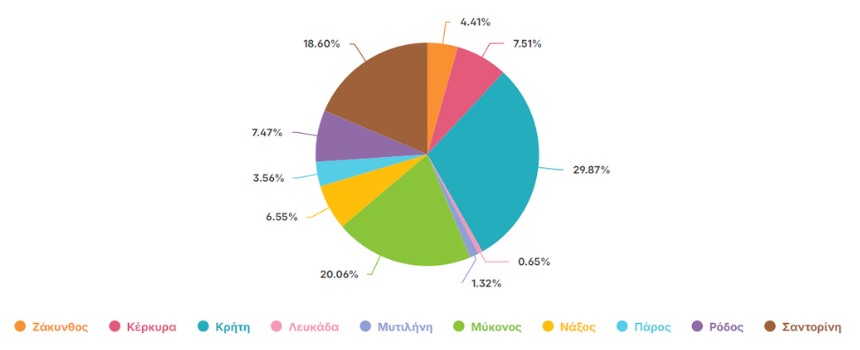
- Crete (29,87%): Leads the digital dialogue due to its size and the variety of experiences it offers: history, nature, gastronomy. During the period examined, its image was affected by a double crisis: wildfires that led to mass evacuations and significant damage, and a sudden increase in migrant flows straining local infrastructure. Social media conversations highlighted both the impact of the climate crisis and the social challenges facing the local community and tourism.
- Mykonos (20,06%) and Santorini (18,6%): Achieved impressive presence, boosted by luxury travel, content creators, and news coverage.
Sentiment analysis
To understand the overall impression left on the public, we analyzed the sentiment of mentions (positive, negative, neutral) for the examined period: 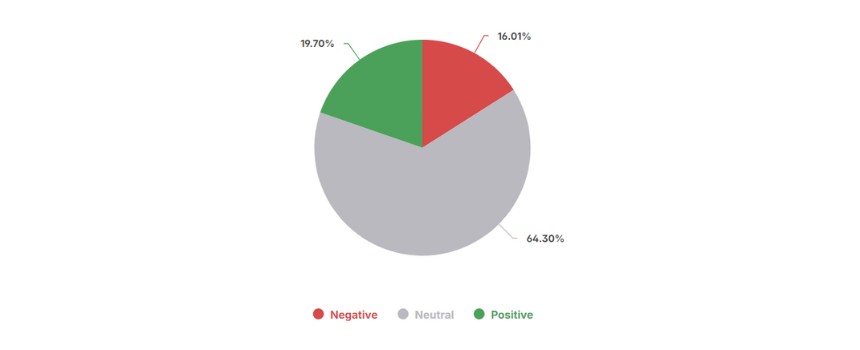 Overall sentiment for the 10 islands shows:
- 3% of mentions were neutral (usually descriptive)
- 7% were positive
- 16% were negative
Sentiment per island
By analyzing the sentiment for each island individually, we get a more targeted view of how travelers experience each destination and where the most intense positive or negative comments are found: 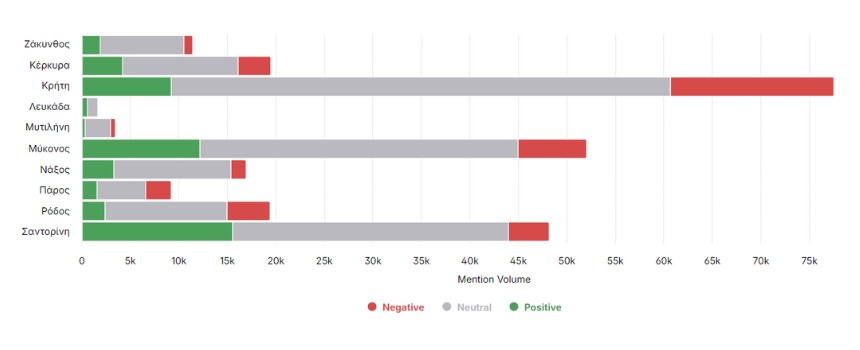
Crete
Crete stood out for the diversity of tourist experiences: from beaches and archaeological sites to traditional cuisine, prompting positive comments on authenticity and local hospitality. Culinary videos featuring traditional dishes and photos from Elafonisi gained notable engagement. Negative comments focused on the early July wildfires, hotel evacuations, extreme heat, and complaints about slow public transportation.
Mykonos
Mykonos was a top subject on social media, with positive mentions about vibrant nightlife, luxury beach clubs, and celebrity sightings (e.g., visit by tennis player Novak Djokovic). Users highlighted fashion, gastronomy, and high-end hotel experiences. However, complaints surfaced about excessive prices (€25 for coffee and water on a sunbed), overcrowding, and a sense of “overtourism” that many felt altered the island’s character.
Santorini
Santorini garnered extremely positive comments for its aesthetics, with references to the Oia sunset, whitewashed villages, and romantic dinners. Popular themes included weddings, honeymoons, and organized food tours. On the flip side, some travelers complained about overtourism, transportation challenges due to the island’s steep terrain, and high prices. There were also views that described the island as “overrated.”
Rhodes
Positive comments mainly came from tourists who visited historical landmarks such as the Medieval Town and the Acropolis of Lindos, as well as those who enjoyed vegan options in new hotels. However, negative buzz increased due to protests by pro-Palestinian activists against the arrival of an Israeli cruise ship, with heavy police presence and reports of excessive force. The incidents caused reactions, with many visitors expressing surprise at the atmosphere and difficulties accessing tourist spots due to the demonstrations.
Zakynthos
Zakynthos received positive mentions for the natural beauty of Navagio Beach, organized boat tours, and the ease of exploring “hidden” beaches. Many users praised the nightlife in Laganas, although there were serious mentions of incidents involving drunk tourists and safety concerns, especially during peak student arrival periods. The balance between fun and responsibility was a recurring theme during the period.
Corfu
Positive references focused on the cultural experience and natural beauty, especially in areas like Kanoni and Pontikonisi. Users praised the photo opportunities and the “fairytale” vibe of the island. Conversely, negative comments were recorded about the airport: limited space, slow service, and overcrowding led to disappointment.
Lefkada
Lefkada received excellent comments for Porto Katsiki and Egremni beaches, as well as for sports, like windsurfing. It was praised as a value-for-money destination with an authentic vibe and alternative tourism options. However, comments noted access difficulties without a car and insufficient amenities in more remote areas of the island.
Naxos
Travelers highlighted the gastronomic aspect, local products (like Arseniko cheese), the family-friendly atmosphere, and organized beaches. On the other hand, there were some negative experiences regarding service variety in hotels and complaints about unreliable service, mainly related to bookings and transportation.
Paros
Positive comments focused on the scenic towns (Naousa, Lefkes), the calm yet stylish atmosphere, and the balance between romance and fun. Its distinction by New York’s travel magazine “Travel + Leisure” as the “Best Island in the World for 2025” drew additional positive mentions. Negative mentions related to overcrowding and parking difficulties in popular spots.
Lesvos
Users praised the authentic experience, local flavors (Plomari ouzo, seafood), and the hospitality of the locals. Strong positive posts highlighted tranquility, nature, and the island’s cultural identity. Negative aspects of the conversation included the migration issue, infrastructure problems, and the lack of organized tourism packages for more demanding visitors.
Topics cloud
The topics cloud offers a “taste” of the themes and mood of users: 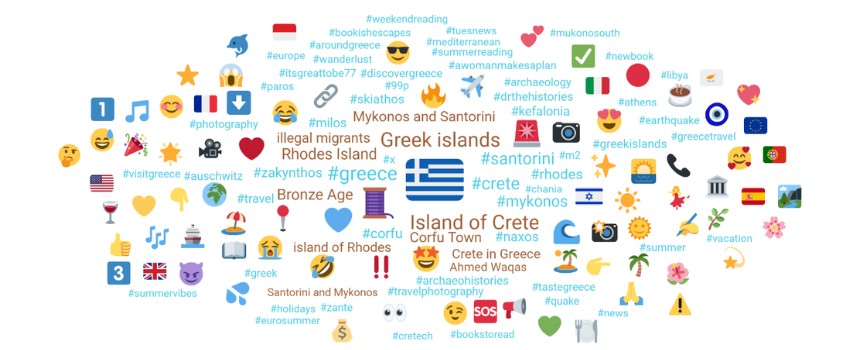
- Hashtags like #greekislands, #tastegreece, #crete, #travelphotography reveal the touristic perspective.
- Emojis like ☀️🍷🏖️📸 suggest positive vibes, fun, and summer relaxation.
- Terms like “illegal migrants,” “earthquake,” “fires” indicate that conversations also include socio-political issues, especially on islands associated with such matters (Lesvos, Crete).
Sources breakdown
The collected mentions come exclusively from social media platforms and represent public data: 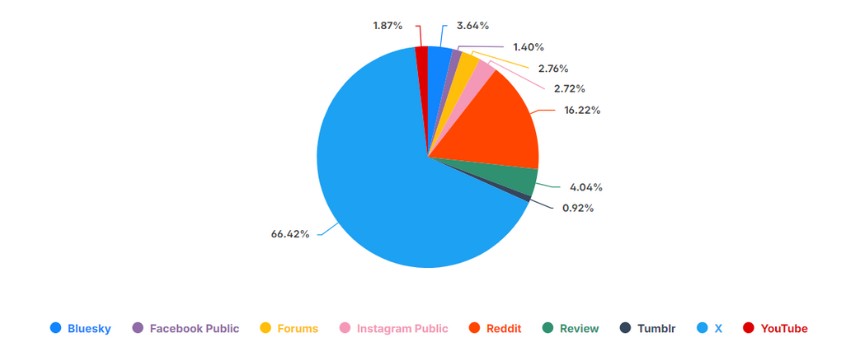
- X (Twitter): Dominant channel (66.42%) with quick, spontaneous, and often humorous responses from users.
- Reddit: At 16.22%, hosts more extensive experiences and discussions, mainly from travelers describing what they liked or disliked.
- Other platforms, such as Instagram and Facebook, contributed visuals and check-ins.
Why Social Listening Matters
Even a quick look at the June-July data revealed a wealth of useful and actionable insights for each island destination. A deep-dive analysis would certainly uncover even more: from traveler preferences and micro-trends to the factors shaping sentiment and influencing decisions to visit or return to a destination.
Businesses operating on the islands have real room to adjust their strategies for the remainder of the summer. From content marketing and influencer partnerships to handling negative experiences and improving the overall traveler experience, social listening offers a crucial competitive advantage: the ability to respond immediately and strategically in real-time, based on how visitors themselves perceive and describe the destination.
Social listening, therefore, isn’t just for major brands or international campaigns. Even without monitoring a specific brand name, the name of a destination can reveal valuable insights into how the public perceives that place. A business influenced by an island’s image and invested in branding, like a hotel, a travel agency, a transportation or food service, can leverage this data to understand traveler expectations, improve the experience it offers, or design more targeted communication efforts.
Analysis identity
Social Listening Tool: Brandwatch
Date Range: 01/06/25 – 30/07/25
Sources: Social media*
Keywording/Analysis: Clip News
*The analysis is based on publicly available data from social media channels only in the English language, with no geographic restrictions on country of origin.
Search Limitations: The Brandwatch platform collects data from websites, blogs, forums, social media (X, Facebook, Reddit, Tumblr, etc.) with the restrictions defined by each channel. For example, discussions in closed forums and Facebook private groups, or Instagram Stories, are not collected. The above analysis provides an indicative approach, taking into account that varying sources and date range may produce different insights.

How did an Adidas drone show near the Acropolis of Athens cause thousands of reactions in only a couple of hours? Clip News’ team uses the Brandwatch platform to present a digital listening analysis. From top hashtags to total sentiment, the following case study shows how new-generation monitoring is turned into a communication strategy tool.
Public outcry for the Drone Show
The recent Adidas drone show that took place at Zappeion Hall caused public outcry. The spectacular show, which included the hologram of a huge Adidas shoe with the Acropolis monument in the background, raised serious questions about whether commercial advertisements near historical locations are proper.
Politicians and supporters of Greece’s cultural heritage denounced the Adidas drone show as a blatant commercialization of the Greek cultural identity. At the same time, reactions flooded social media. Some users mocked the situation, while other expressed serious concerns over the impact of Acropolis’ commercial exploitation. The dispute led to an investigation by the Athens First Instance Prosecutor’s Office and to lawsuits by the Greek Ministry of Culture against any other person liable. On their side, the organizers of the event claim that all legal procedures were followed.
Key Takeaways
Clip News analysts studied 13,090 publicity references from Websites, Blogs and various Social Media channels over the period 15-19 May 2025. Public discussion focused on the commercialization of cultural heritage, with 4,994 unique authors expressing intense opinions, from condemnation to humorous comments.
The trending topics include phrases like “Adidas over the Acropolis” and “Adidas ad at Acropolis”. Online news was dominated by the statements of the Greek Minister of Culture, Lina Mendoni, and articles of cultural and political content..
Volume over Time
Publicity skyrocketed on 16 May 2025, one day after the drone show. Volume exceeded 600 references per hour and buzz stayed quite high until 18 May, proof of the intensity and duration of the reaction in the digital environment.
Keywords, Hashtags & Emojis
The word cloud flooded with phrases like “lawsuits against any other person liable”, “prosecutor intervention”, “explanations in writing”, “Adidas shoe”. Top hashtags were #adidas, #acropolis και #mendoni. The emojis used were of particular interest. The dominant one was 🤡, suggesting irony, criticism and the surge of user emotions.
Media Sources
Out of the publicity sources selected for analysis, 76% of references came from X (formerly Twitter), 21% came from news websites, 2% from Facebook, 1% from Reddit and less than 1% from blogs. As far as the X references are concerned, 55% of the users were men and 45% of the users were women, a sign of broad demographic participation in the discussion.
Sentiment Analysis
Some 48% of the references were negative and 52% of the references were neutral. No positive references were recorded, which proves that the entire situation mostly raised concerns.

Top Sites and Top X Posters
The websites with the biggest influence, based on the Impact* index, were “protothema.gr”, “iefimerida.gr”, “news247.gr”. In terms of X accounts, “grok” and “skaigr”, as well as journalists “NChatzinikolaou” and “KostasVaxevanis”, had the biggest impact, based on their numbers of followers. *Impact: It is a metric the potential impact of an author, site or mention. It is a logarithmic scale between 0-100 and depicts how “important” something is.
Why Digital Listening matters
The Adidas Drone Show case highlights the importance of digital listening and real-time monitoring. Through advanced social media monitoring and internet monitoring tools, like Brandwatch, brands from every sector, culture and communication officials in this particular case, are able to:
- locate trends and crises at their onset
- analyze sentiment (positive, neutral, negative) and the origin of the discussion
- evaluate data for strategic reactions and repositioning.
For organizations that handle reputation or brand image issues, real-time media monitoring and the analysis of publicity data from different sources are necessary tools in contemporary communication strategy.
Analysis identity
Digital Listening Tool: Brandwatch
Date Range: 15-19/05/2025
Sources: websites, blogs, forums, social media (subject to the limitations of each channel)
Keywording/Analysis: Clip News
Search Restrictions
The Brandwatch platform collects data from websites, blogs, forums, social media (X, Facebook, Reddit, Tumblr, etc.) with the restrictions defined by each channel. For example, discussions in closed forums or Facebook private groups are not collected.
The above analysis provides an indicative approach, taking into account that varying the publicity data sample and time range may produce different insights.

LinkedIn Monitoring: How Greek Banks Can Win the LinkedIn Game With the Aid of Reliable Data
At a glance
LinkedIn constitutes a crucial communication strategy tool for banks. AMEC award-winner Clip News offers specialised LinkedIn Monitoring solutions, aiming at strengthening reputation, optimizing strategy and understanding competition, by using real-time data from the Clip News Portal platform.
Objectives
- Real-time LinkedIn Monitoring & communication action recording
- Understanding sentiment (positive, neutral, negative) & thematic clustering
- Improving content strategy & keeping tabs on competition
Solutions
- AI-powered data collection, by monitoring keywords, hashtags & users
- User-friendly platform with real-time alerts
- Competitive benchmarking
*Premium Solutions:
- Tagging per topic or category & correction of sentiment in all data
- Custom reports with KPIs by analysts
Benefits
- Complete control over the brand’s LinkedIn presence & monitoring of competition actions
- Increase of target-audience engagement & timely handling of publicity crises
- Improved data-based decision-making
Why LinkedIn Monitoring & Why Now?
LinkedIn is currently the most powerful professional social media channel for banks, both on a corporate publicity level and on a networking and development level. With more than two million users and over 55,000 companies in Greece, LinkedIn has become an integral part of every decent communication strategy. LinkedIn is not yet another social media channel, but a tool that helps brands gain publicity, strengthen their reputation and create trust.
However, simply being present at LinkedIn, without monitoring and data, is like walking in blindfold. The Analytics that LinkedIn platform includes offer important insights about owned posts, meaning your posts. However, the ability to locate all references to your brand or directly compare with competition references is limited.
Banks Under the Microscope
To understand how our new LinkedIn Monitoring service can prove useful for brands, we selected systemic banks for the reasons below that also apply for many professional sectors:
- LinkedIn has turned into a fully operational marketing channel, which can autonomously support the promotion of new products or services and campaigns.
- At the same time, LinkedIn can supplement omnichannel strategies, significantly strengthening the effectiveness of communication initiatives that are also “running” in other media (i.e., TV, printed media, digital media, PR actions).
- Brands are constantly under the microscope. One wrong post, one negative comment or a misunderstood tone can create an avalanche of reactions.
- PR and marketing teams are asked to quantify the effectiveness of campaigns, corporate social responsibility (CSR) actions or Thought Leadership actions, such as the participation of high-ranking executives in conferences.
Based on the above, we activated a LinkedIn Monitoring account, we selected the right keywords and we collected relevant posts (834) for a period of one month. The procedure allowed us to get data about systemic banks with the below metrics:
- For every post containing the selected keyword: URLs, Hashtags, Reactions count, Comments count
- For every post of a selected author: Username, Followers count, Profile image, Location
The Benefits of LinkedIn Monitoring
- Real-time monitoring of references to your brand
- Who talks about your bank? What do they say? In what tone of voice?
- Locating negative posts by LinkedIn users, competitors and bank employees.
Undoubtedly, LinkedIn Monitoring does not prevent publicity crises. However, it helps manage them immediately and restore the trust of your clients.
- Competitive benchmarking
- What content of other banks causes engagement?
- When do they publish and what format do they use (polls, videos, multi-image posts)?
- What are the gaps that you can use in your own benefit?
With the right data always at your disposal on a Monitoring platform, you can monitor the actions of your competition and adjust your content, in order to keep up with a trend of your sector or differentiate yourselves.
- Recording Topics & Sentiment
- How does the sentiment (positive, neutral, negative) about your brand change in the course of time?
- What does the audience expect from your communication? What topic causes the biggest engagement? Sustainability, CSR actions, new products or new services?
Understanding what the audience finds interesting allows you to create content that increases trust, bolsters interaction and improves the total image of your brand.
What we monitor, plain & simple
- Keywords: Words, phrases or hashtags that are important to you (the name of a brand, a company or a person).
- Authors: Active LinkedIn users in Greece (more than a million users, the number is on the rise).
Why Clip News?
Clip News offers specialized LinkedIn Monitoring solutions that allow you total control over your digital presence. Real-time alerts, AI technology and specialised analysts supply you with reliable publicity data that allow you to monitor, analyse and optimise your strategy.
- User-friendly platform with real-time alerts
- Real-time alerts about LinkedIn references related to the keywords and/or pages you are interested in.
- Dashboard that allows the easy monitoring of LinkedIn data.
- Measurable results to decide what works best.
- AI-powered tool & human expertise
- Use of advanced AI algorithms for data collection.
- Supervision by media monitoring professionals to make sure results are correct.
- Tagging και sentiment analysis (positive, neutral, negative).
- Specialization in banking & and financial brands
- Experience in the analysis of financial sector publicity.
- Profound knowledge of the banking sector and of its distinctive communication characteristics.
- Custom Reports with KPIs set by you.
Next Step
Try LinkedIn Monitoring In Action:
If you wish to protect the reputation of your brand, measure the efficiency of your actions or better understand your competition and your audience, Clip News most definitely has the tools and know-how to offer you reliable data that would lead to data-driven decisions.
Ask for a free demo and discover how you can improve your LinkedIn strategy with real-time data.
 Portal Login

