
The rapid rise of Artificial Intelligence (AI) in public discourse has turned tools like ChatGPT, Grok, and DeepSeek into key players in the digital conversation. Leveraging Brandwatch digital listening platform, Clip News analyzed 144,499 online mentions in Greece between January 1 and July 10, 2025, uncovering trends, concerns, and opportunities related to AI. The dataset consists of public mentions from websites, blogs, forums, and social media, focused on the following keywords: Grok, ChatGPT, DeepSeek, Gemini, Perplexity, Claude, Llama, Mistral, Cohere, and Ernie Bot. 
Key takeaways
A qualitative analysis of the data reveals five major trends that dominated the AI conversation in the first half of 2025, spanning politics, safety, personal life, and entertainment, showcasing AI’s wide societal, political, and cultural impact:
- AI in Political and Social Commentary
AI tools like ChatGPT were widely used to explore sensitive issues such as the Tempi train tragedy and minimum wage debates, highlighting both AI’s influence on public opinion and concerns about algorithmic bias.
- Environmental and Geopolitical Concerns
The emergence of DeepSeek triggered discussions about energy consumption, data privacy, and a potential new Cold War between the U.S. and China over technological dominance.
- AI and Personal Relationships
Cases such as divorces initiated due to AI findings revealed the growing role of AI in interpersonal matters, raising ethical and legal questions about its use in private life.
- Security and Document Forgery
The use of AI to generate fake passports underscored vulnerabilities in automated ID systems and fueled demands for tighter regulation.
Users’ trust in AI predictions for sports outcomes marked a shift in fan engagement and betting behaviors, positioning AI as a new player in sports commentary.
Buzz Growth
Mentions of AI tools surged 386% compared to the previous six months (up from 29,758 to 144,499). 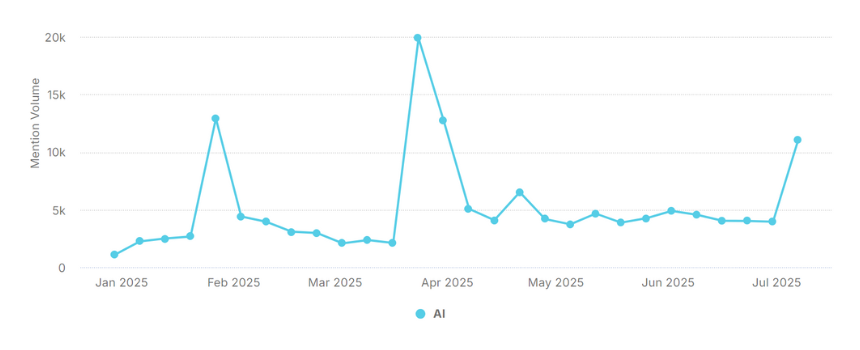 Two notable peaks occurred:
- January 27 – The launch of DeepSeek sparked significant volatility in global financial markets.
- March 24 – Users engaged AI tools like ChatGPT and Grok to discuss politically charged topics.
Share of Voice
The Share of Voice analysis reveals which AI platforms dominated the public dialogue in the first half of 2025. 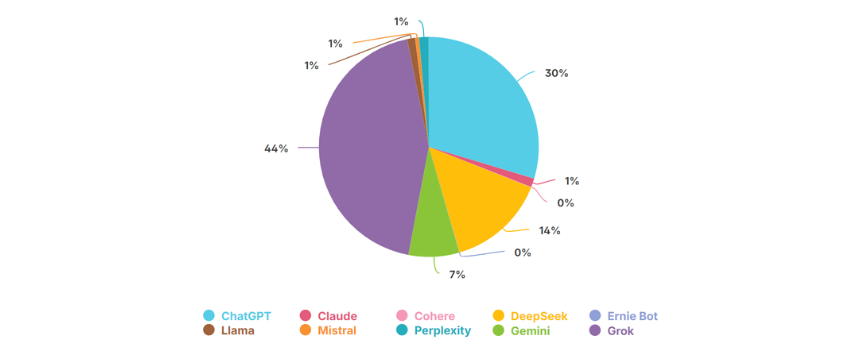
- Grok led with 44%, largely due to its unfiltered responses, provocative tone, and controversial takes on social and political matters on X (Twitter).
- ChatGPT followed with 30%, recognized for its utility in everyday queries and political discussions.
- DeepSeek accounted for 14%, reflecting its swift market entry and geopolitical relevance.
- Other tools, such as Gemini (7%), Claude, Perplexity, Cohere, and Llama, registered single-digit SOV, indicating lower awareness or niche usage in the Greek digital sphere.
Sources breakdown
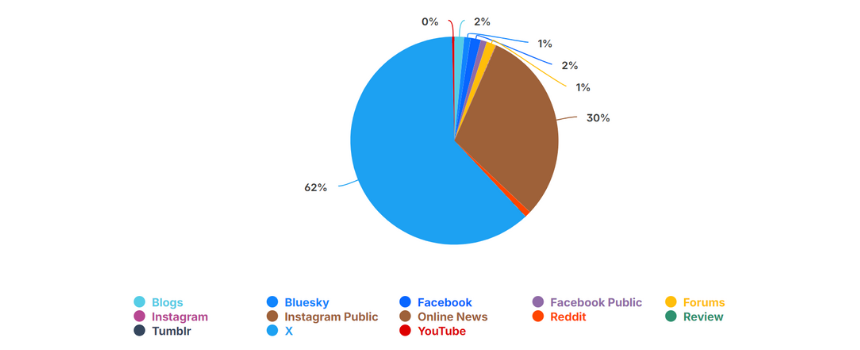
The breakdown per source shows that:
- X (Twitter) dominated with 62% of mentions, serving as the main arena for humor, commentary, and real-time interaction with tools like Grok, which answers within discussions.
- News websites followed with 30%, focusing more on the ethical, technological, and political implications of AI.
Topic cloud
The analysis of publications and posts reveals a wide range of topics that shape the collective perception around Artificial Intelligence. The topic cloud, as depicted on the Brandwatch platform, includes keywords, hashtags, and emojis, which serve as indicators of sentiment, themes, and cultural reactions. 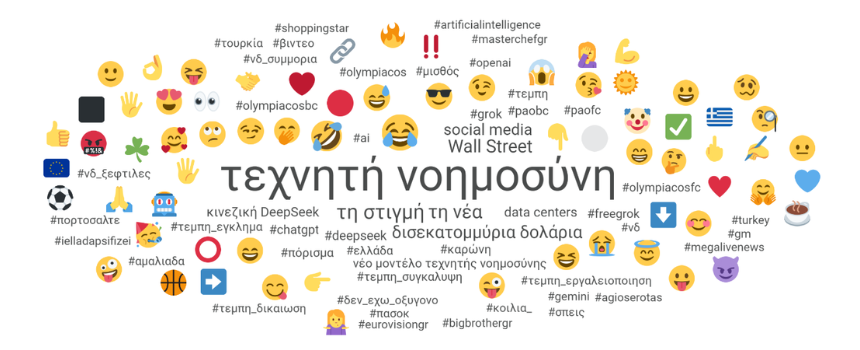
Terms like “new model,” “data centers,” and “billions of dollars” reflect AI’s revolutionary status and its ties to economic power.
- Political Satire & Debate
Hashtags such as #τεμπη_συγκάλυψη (Tempi cover-up), #νδ_ξεφτιλες (ND disgrace) show AI being used to probe political scandals, raising public doubts about AI neutrality and its impact on civic perception.
The presence of hashtags such as #olympiacosbc, #paobc, #paofc, as well as emojis like 🏀, ⚽, and 🏆, shows a strong connection between AI and sports, using it as a “smart commentator.” Users either ask for result predictions or use AI applications for humorous or forecasting comments.
- Everyday Humor & Casual Use
The widespread use of emojis and playful queries (e.g. “I dreamed of a white dove, what does it mean?”) demonstrates how AI has permeated everyday conversations, especially with Grok’s unpredictable, sometimes profane, replies.
- Tech Rivalry & Innovation
Mentions of ChatGPT, DeepSeek, Grok, Gemini, and terms like “Wall Street” and “OpenAI” point to a narrative shaped by big tech rivalries, model innovation, and concerns over monopolistic power.
- Ethical Concerns & Misinformation
Emojis like 🧠😱😐 and terms like “surveillance,” “control,” “data” suggest a growing unease about AI’s ethical use and manipulation of information.
Food for thought
With a quick analysis of more than 140,000 posts and comments, we gathered critical information and conclusions on serious issues affecting society, politics, technology, and daily life. This particular case highlights the vast potential of digital listening as a tool for strategic understanding of the audience, the topics that concern them, and the dynamics of public discourse in real time.
Through a targeted deep-dive analysis of Brandwatch data, communication professionals can extract more specialized insights, identify crucial narratives, and design strategies based on real data.
Analysis Identity
Digital Listening Tool: Brandwatch
Date Range: 01/01/25 – 10/07/25
Sources: Websites, Blogs, Forums, Social media
Keywording/Analysis: Clip News
Search Limitations: The Brandwatch platform collects data from websites, blogs, forums, social media (X, Facebook, Reddit, Tumblr, etc.) with the restrictions defined by each channel. For example, discussions in closed forums and Facebook private groups, or Instagram Stories, are not collected. The above analysis provides an indicative approach, taking into account that varying the publicity data sample and time range may produce different insights.

The AI Report Excellences 2025 awards ceremony, organized by Teamworks – MetaTeam in collaboration with AI Report magazine, took place on July 15, 2025, at the Divani Caravel Hotel, attracting a large audience from both the public and private sectors, leading tech organizations, and state representatives.
The event spotlighted pioneering initiatives in artificial intelligence and digital transformation, from optimized public sector solutions to sustainable tech applications and private sector analytics platforms.
During the ceremony, Deputy Minister of Digital Governance, Christos Dermetzopoulos, highlighted the benefits of responsibly integrating AI in public services, emphasizing its role as a tool that “enhances transparency and efficiency in public administration”.

Clip News: Honored for AI Summary Report
Clip News was recognized in the AI & Data Analytics Platforms category for its AI Summary Report, affirming its leadership in media monitoring technology. The distinction underscores the company’s commitment to fast, reliable, and high-quality publicity analysis tailored to the needs of communication and marketing professionals.
Clip News Vice-President of Media Intelligence, Katerina Kechagia, accepted the distinction from Dr. Alexandros Varveris, Governor of e-EFKA. “This award for our ‘AI Summary Report’ confirms that our strategic investment in innovation and artificial intelligence is bearing fruit. I want to thank the entire Clip News team for their dedication, as well as the brands that trust our technology and expertise. AI is already transforming the communications landscape,” Ms. Kechagia noted.

Founded in 1999, Teamworks – MetaTeam aims to create communication channels across the Greek ICT market. The company operates in the fields of conferences, digital and print media, and communication tool development for the digital technology sector.
By connecting businesses, public entities, IT professionals, policymakers, and academic institutions, Teamworks highlights entrepreneurship and social impact initiatives in the field of Information and Communication Technologies (ICT), a crucial sector to Greece’s development.

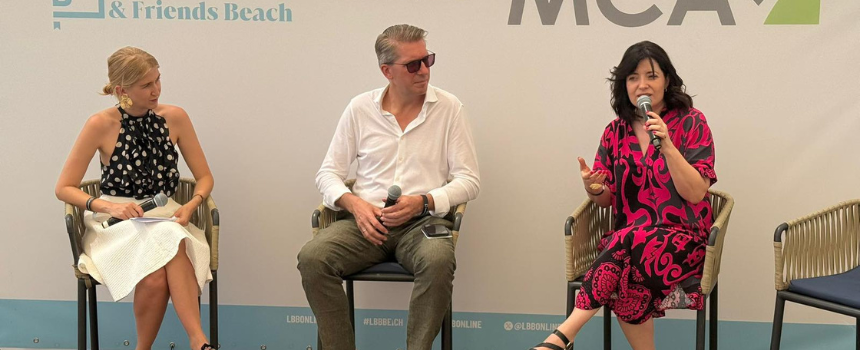
On June 18, 2025, as part of the “PR in Cannes” event, hosted by the International Communications Consultancy Organisation (ICCO), an insightful and timely panel discussion took place titled “Driving Measurable Impact in Media Intelligence & PR”, featuring three leading professionals in the field:
- Katerina Kechagia, Vice President of Clip News and of FIBEP
- Florian Laszlo, CEO of Austrian company OBSERVER
- Zuzana Richterova, Secretary of FIBEP
The discussion was held on LBB Beach, in a dynamic and quite hot setting (both literally and figuratively), where professionals from the fields of public relations, media monitoring, and data analysis exchanged views on the current state and prospects of the media intelligence industry.
What is Media Intelligence
As introduced by Zuzana Richterova, media intelligence refers to the process of monitoring, collecting, analyzing, and interpreting content from various media sources (print, digital, broadcast, and social) to extract meaningful insights about reputation, communication strategy, and decision-making for organizations and brands.
Key Challenges and Trends
In her remarks, Katerina Kechagia presented the findings of the latest “State of the Industry Survey” (SOI) by FIBEP, the World’s Media Intelligence Association:
- Stability and Resilience: 90% of companies in the industry expect stable or growing revenues over the next year. Media intelligence proves to be resilient and an essential service for businesses.
- AI – From Future to Present: One-third of companies already use AI for services such as content categorization, sentiment analysis, and language processing. AI accelerates workflows but also reshapes cost structures and client expectations.
- “More for Less” Mentality: Clients demand more insights, faster delivery, and lower cost. The pressure on efficiency requires service redesigns.
- Need for New Skills: 60% of companies report the need to retrain their staff to keep up with technological developments.
- Content Licensing: The biggest obstacle is the absence of a consistent global framework for fair, clear, and sustainable content use, which creates inequalities, costs, and legal uncertainties.

Media Rights Trust Initiative
Florian Laszlo presented FIBEP’s “Media Rights Trust Initiative” (MRTI), a step toward fairer content licensing. Its aim is to build a collaborative framework among media monitoring agencies, publishers, PR professionals, and Collective Management Organizations (CMOs) by:
- Creating unified and transparent content licensing models
- Balancing cost with value
- Promoting innovation while reducing legal uncertainties
Next Steps
Anyone interested in learning more about the “Media Rights Trust Initiative” can visit fibep.info/mrti.
Industry professionals are expected to gather again at the World Media Intelligence Congress, which will take place this year in Düsseldorf, from September 30 to October 2, 2025.

Technology is evolving rapidly, and with it, the entire field of media intelligence is being transformed. In this context, the International Association of Media Monitoring Companies (FIBEP) publishes its annual State of the Industry Survey (SOI), capturing the challenges, opportunities, and trends impacting media monitoring and analysis companies around the world.
This year, Katerina Kechagia, Vice President of Clip News and Vice President of FIBEP, had the opportunity to speak on the Media Intelligence Explained podcast about the survey’s findings and how they can be translated into practical strategies for businesses in the industry.
Key Findings from the 2024 Survey
- Positive industry outlook: 66% of companies reported stable or increased revenue, while 92% expect a stable or upward trend.
- Artificial Intelligence in the spotlight: 33% of FIBEP members already use AI in at least one service. Companies are expected to invest not only in technology but also in upskilling their human capital.
- Evolving client demands: Clients are seeking more than simple information. They want meaningful analysis and a consultative approach, while also expecting lower prices thanks to automation.
- Data fragmentation & regulatory challenges: The complexity of information sources and copyright regulations present new obstacles that require broader industry collaboration.
How Businesses Can Use the Survey
Katerina Kechagia proposed two main ways:
- Benchmarking: Each company can compare its performance against industry data to identify strengths and weaknesses.
- Strategic planning: The trends and findings provide a “roadmap” for future moves – whether that means investing, or redefining services.
The participation of Clip News and Katerina Kechagia in the survey and podcast highlights the company’s active role in shaping the future of media monitoring and the broader media intelligence sector.
The International Association of Media Monitoring Companies (FIBEP), now known as the World’s Media Intelligence Association, is the global federation of media monitoring companies. Clip News has been a member since 2002, contributing in various capacities and having hosted two global congresses as host sponsor: one in Limassol in Cyprus, in 2024 and another in Thessaloniki in 2011.
Listen to the Full Podcast
Listen to the full discussion in YouTube.

Clip News was a sponsor at the AI in Marketing Conference 2025, which was organised by Boussias Events and held at the OTEAcademy with the participation of top communication, marketing and technology executives. The Conference highlighted the decisive role that AI plays in strategic marketing, data analysis, content creation and the protection of the reputation of brands. Supporting such initiatives reflects Clip News’ unfaltering commitment to innovation and to connecting technology and communication.
Clip News Vice-President takes the stage
Clip News Media Intelligence Vice-President, Katerina Kechagia, delivered a speech on “AI-Powered Media Monitoring: Transforming Marketing Strategies with Real-Time Insights” and dwelt on the way AI transforms media monitoring, from a publicity recording tool into a strategic ally. Emphasising the importance of tracing crises in real-time, analysing sentiment (positive, neutral, negative), and predicting trends, Ms Kechagia stressed that brands can now bolster their narrative and maximise audience engagement. At the same time, she referred to the ethical and moral implications of AI use, giving prominence to the role of human supervision and data transparency.

During her speech at the AI in Marketing Conference, Ms Kechagia also referred to the recent, real case study of the National Gallery vandalism by Nikos Papadopoulos, a member of “NIKI” political party. The topic had 2,156 articles, posts and comments on websites and social media in only two hours. References skyrocketed to over 100,000 in 10 days! Marketing and communication executives can use technology, without “sacrificing” control over the image of their brand, by using tools such as:
- Thematic clustering
- Real-time monitoring
- Sentiment analysis
- Email alerts
And mainly… by combining human experience with AI technology.

What the rest of the speakers said:
- Demi Kazasi (Digital Team Member, Hellenic Advertisers Association) spoke about redesigning the international marketing process, focusing on digital experience and experimentation.
- Nicole Mezzasalma (Senior Consultant & Innovation, Battenhall) spoke about the way AI affects social media strategy, using examples and tools.
- Charlie Hills (Founder, Cognified) explained how to produce authentic AI content that truly transforms and does not drive the audience away.
- Ioustini Papavasileiou (Business Unit Director – Marketing Strategy, Consumer Insights & MarTech Solutions, MAX Greece) described how AI helps reduce media waste and create effective, data-driven campaigns.
- Oliver Yonchev (Founder, cocreatd) challenged the rumour that AI “kills” creativity, suggesting ways to make the two coexist.
- Eleanna Tavlikou (Instructor, Knowcrunch & Digital Creator, Human Minds) dwelt on how AI revolutionised visual media, with case studies on personalised and effective content.
- Elena Bouka (AI Legal Counsel) spoke about EU legislation on AI, restrictions, regulations on generative AI and what the above mean for marketing.
- Tania Giakoumaki (General Manager, Curious Ahead) spoke about the integration of AI into business development and branding strategies.
- Christos Passas (Digital Business Unit Director | Head of AI, Curious Ahead) introduced the notion of Generative Engine Optimization (GEO) and the need to protect reputation in AI-driven searches.
- Dan Debnam (Founder, Inovara) explained how AI agents radically change SEO and content search.
- Jérémy Grandillon (CEO, TC9) highlighted how AI can eliminate time-consuming sales procedures and increase performance.
Final Insights – Lessons and Prospects
The last discussion at the first day of the AI in Marketing Conference, coordinated by journalist Robert Pefanis, highlighted the main trends and next steps in using AI in marketing. The discussion saw the participation of Ioannis Kamilakis (Marketing Director, Public Group), Panos Bassios (Digital, Data & Analytics Director, MSD) and Marily Mitropoulou (Country Marketing Manager, Plum) and focused on the implementation of AI technologies in sales, content and strategy.

Clip News continues to dynamically invest in a future where media monitoring uses AI, by attending important conferences and by supporting the creative and strategic transformation of the market. Join us in keeping up with the developments – because information is fire and AI is its accelerator! For more information on the AI in Marketing Conference, click here.
 Portal Login
